


Zapier vs Custom Python Automation: When Each One Wins
The short answer: use Zapier or Make while a workflow is simple, low-volume and runs on apps they already connect. Move it to n8n or custom Python when per-task fees outgrow the upkeep of your own code, when the logic needs real code, or when a system has no connector. Most businesses end up running both.
- Pricing models compared, as of November 2026
- A worked cost crossover at real volumes
- Examples from automations we run in production
Last reviewed by Andrii Zarubin, Founder
At a glance
Zapier, Make, n8n and Custom Python Compared
The four options differ less in what they can connect than in what you pay for. Zapier charges per action step, Make per module action, n8n per workflow run, and custom code charges nothing per run but costs engineering time to build and keep running. Prices are list prices with annual billing, checked in November 2026.
| Zapier | Make | n8n | Custom Python | |
|---|---|---|---|---|
| You pay per | Task: each successful action step. Triggers, filters and formatters are free. | Credit: most module actions use one; some AI features use more. | Execution: one run of a whole workflow, however many steps it has. | Nothing per run. You pay for building it, upkeep and a server. |
| Entry price | Free for 100 tasks; Professional from $19.99/month for 750 tasks. | Free for 1,000 credits a month; paid plans start at about $9/month for 10,000 credits. | Cloud Starter €20/month for 2,500 executions; the self-hosted Community Edition is free. | Build at £50 / $70 an hour; a small server costs about $10–20 a month. |
| At volume | 10,000 tasks $129/month; 50,000 $289; 100,000 $489 (Professional). | Credit bundles at the price set by your plan. | Cloud Pro €50/month for 10,000 executions; self-hosted has no execution limit. | The same cost at 100 runs or 100,000. |
| Custom logic | Code steps, which also count as tasks. | Functions and routers inside a scenario. | JavaScript and Python code nodes in the workflow. | Anything: tests, retries, rules engines, your own libraries. |
| Who holds the data | Zapier's cloud. | Make's cloud. | n8n's cloud, or your own server. | Your own server. |
| Best when | Simple flows between popular SaaS apps, owned by non-developers. | Visual multi-step scenarios at a lower price per action. | Many steps, high volume, or data that must stay on your servers. | Complex rules, systems with no connector, heavy data work. |
Sources: Zapier pricing, Make pricing and n8n pricing, November 2026. Zapier's monthly billing is 50% more than the annual prices shown. Make changed its plans twice in 2026, so check its page for the current tiers.
Worked example
What One Real Workflow Would Cost on Each
Take the invoice automation we run for Total Solution Industries, a Florida field-service company. When a technician closes a work order, the workflow reads it from the company's ERP, picks the right regional price list, has an AI model match the technician's notes to line items, applies the labour floor in code, writes the invoice back, and adds an itemised internal note. It handles about 50 work orders a day, roughly 350 a week.
- On Zapier: about six counted steps per invoice and about 1,500 invoices a month, so roughly 9,000 tasks. That is the 10,000-task Professional tier, $129 a month billed annually or $193.50 billed monthly.
- On n8n: one execution per run of the workflow, about 1,500 a month, whatever the number of steps. On a self-hosted instance, which is how this one runs, there is no execution fee at all, only the server.
Cost was not why this workflow is code. The ERP has no Zapier or Make app and its API speaks XML, and the price is a deterministic rule applied after the AI match, with a warning when a job is likely to exceed its not-to-exceed cap. That logic needs to live somewhere it can be tested and reviewed. In our experience the logic decides the move more often than the bill does.
The crossover
When Does Custom Code Pay for Itself?
Months to pay back = build cost ÷ (monthly platform fee saved − monthly upkeep). Assume a 40-hour build at $70 an hour ($2,800), two hours of upkeep a month ($140) and a $20 server, replacing a Zapier Professional plan billed annually:
| Tasks a month | Zapier (annual) | Saved after upkeep | Payback |
|---|---|---|---|
| 10,000 | $129 | −$31 | Never, on cost alone |
| 50,000 | $289 | $129 | About 22 months |
| 100,000 | $489 | $329 | About 9 months |
Below about 50,000 tasks a month, stay on Zapier unless the logic or a missing connector forces you off. Above 100,000, or on monthly billing, which costs 50% more, the case for your own code gets strong quickly. Volume also creeps in where you don't expect it: a loop that updates 100 records an hour is 72,000 tasks a month on its own.
Choosing
When Each One Wins
- Zapier wins for a few hundred runs a month between popular apps, owned by someone who isn't a developer. Nothing to host, quick to change.
- Make wins when the same kind of flow has more steps and branches, and you want a lower price per action.
- n8n wins when workflows have many steps or run thousands of times, when you want code steps inside a visual workflow, or when the data must stay on your own servers.
- Custom Python wins for complex business rules, heavy data processing, systems with no connector, and anything that needs proper tests and code review.
The line is rarely no-code against Python. Most of what we run in production is self-hosted n8n with code steps where the logic needs them, and plain Python services where a workflow tool would get in the way.
In production
What We Run, and What It Would Cost on Per-Task Pricing
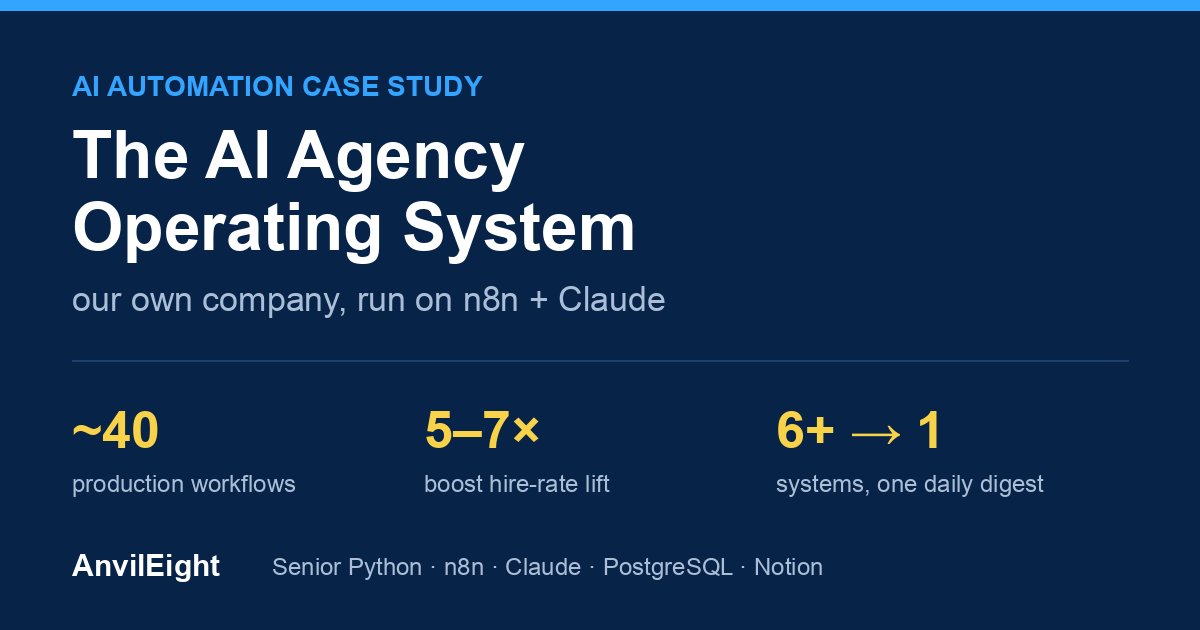
Our own agency runs on about 40 production workflows on one self-hosted n8n instance: a proposal engine that has scored 3,400+ jobs, a sales CRM that files every lead email itself, and a daily digest built from six-plus systems. One workflow syncs every submitted proposal into PostgreSQL each hour. On per-task pricing, that one sync would be billed every hour for every record it touches.
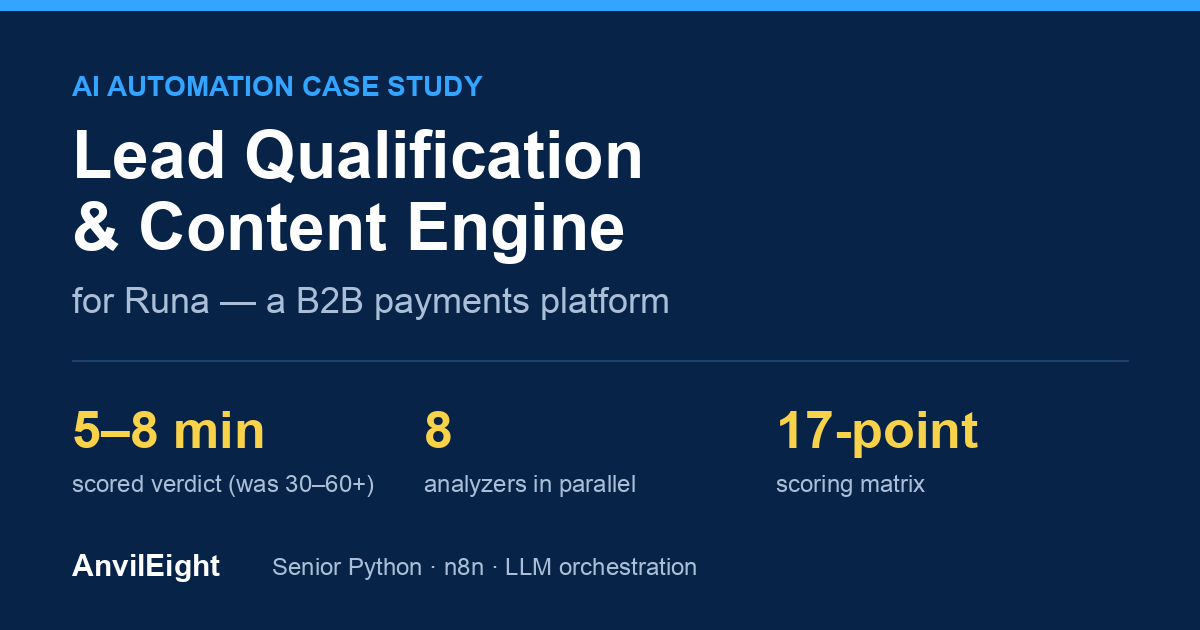
For Runa, a B2B payments platform, the lead-qualification engine fans out to eight analyzers and makes about 16 AI calls for each company it scores. On n8n that is one run per lead. The bigger return was people's time: research per lead went from 30–60+ minutes to 5–8.
Building something new rather than moving off a platform? See our Python automation services and AI automation services, and our rates.
Zapier vs custom automation: FAQ
More questions? Contact us- Is n8n cheaper than Zapier?
-
At volume, usually. Zapier bills every successful action step as a task, while n8n bills one execution per workflow run however many steps it has, and the self-hosted Community Edition has no platform fee at all. For a few hundred simple runs a month the difference is small, and Zapier is quicker to set up.
- When should we move off Zapier?
-
When one of three things happens: per-task fees outgrow what it would cost to maintain your own code (in our worked example, from about 50,000 tasks a month), the logic needs real code such as loops, pricing rules or retries, or a system you depend on has no Zapier or Make connector.
- Can you migrate our existing Zaps or Make scenarios?
-
Yes. We list every Zap or scenario with its monthly task count, keep the cheap and stable ones where they are, and rebuild only the ones that cost the most or break most often. Most clients end up running both.
- How much does a custom automation cost?
-
Our rate is £50 ($70) per hour, or a fixed price per milestone after a free scoping call. A single workflow is often a few days of work. Budget an hour or two a month of upkeep, because the APIs it calls will change.
- Who maintains a custom automation once it is built?
-
We do, if you want us to: the workflows we build report failures to one alert channel, retry with backoff, and are kept in version control. You own the code and can move it to another team at any time.
Contact
Is your Zapier bill growing faster than your business?
Send us your Zap or scenario list with monthly task counts. We'll tell you which to keep, which to move, and what the move would cost. Or email contact@anvileight.com
Review My WorkflowsLet's work together
Don't like forms? Email us to contact@anvileight.com